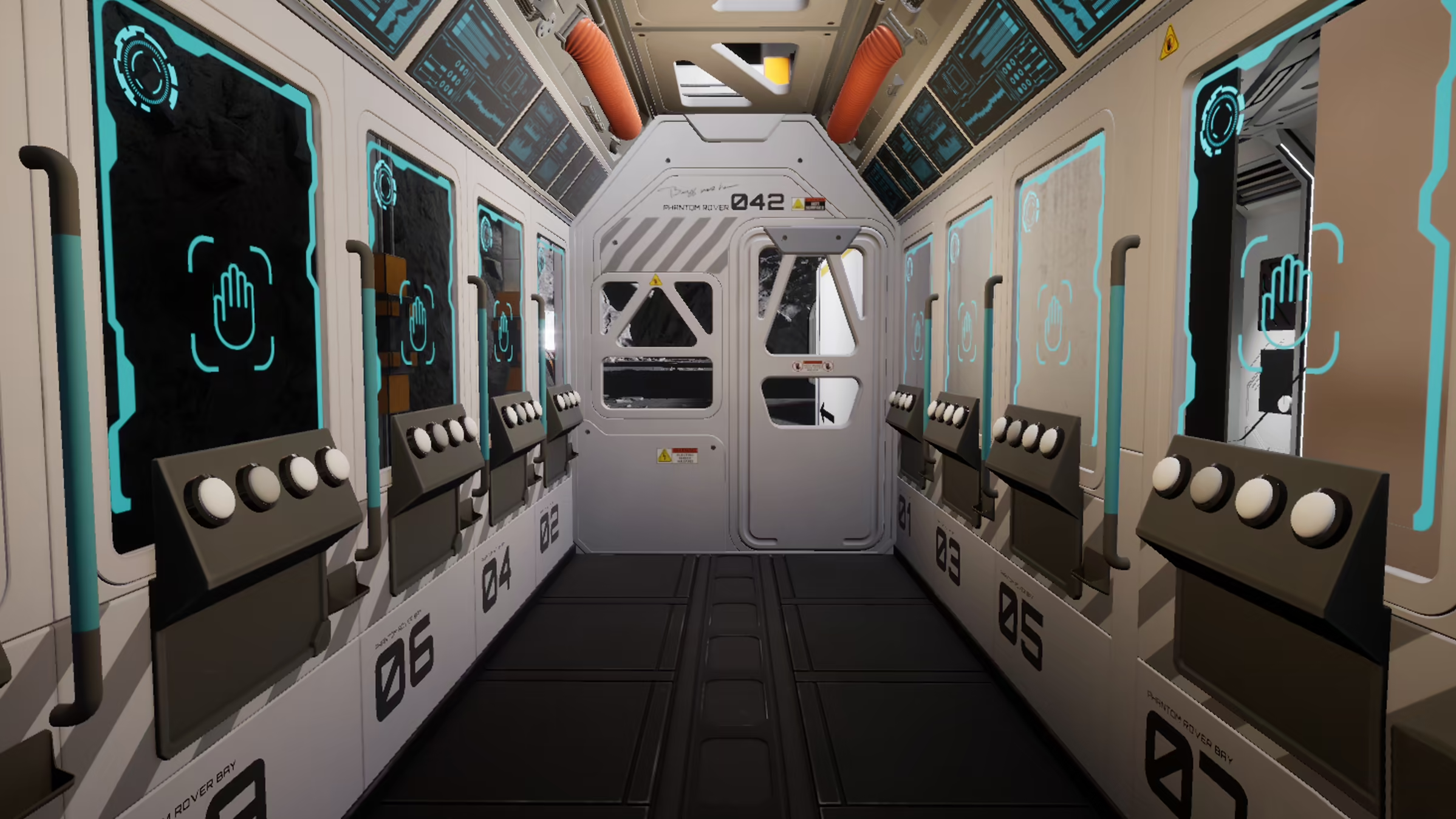
A vertical slice is often treated as a polished promise: one narrow section of the game brought close to final quality. That promise matters, but the most useful slice also reveals the production truth behind it.
If the result depends on heroic effort, temporary systems, or a review process that cannot scale, the slice may prove a vision while concealing the risk of building the rest of the game. A credible slice demonstrates both the intended experience and a repeatable way to produce it.
Choose representative complexity
The slice should include the systems and content interactions that make production uncertain. Select a scenario with representative gameplay density, environment demands, character behavior, UI, audio, and performance pressure.
Representative does not always mean largest. Choose the smallest scenario that still forces important systems to interact under believable conditions. Include the transitions and edge cases that production will repeat, not only the camera angle prepared for a presentation.
Avoid the easiest possible corridor. A slice that bypasses the hard interfaces will create confidence without testing the assumptions that matter.
Build the pipeline with the content
Track how work moves from intent to implementation, review, integration, optimization, and validation. Measure iteration time as carefully as visual quality.
Record where assets wait, where specialists perform manual repair, how often integration breaks, and how long a meaningful creative change takes to reach the build. A beautiful result that requires an unsustainable sequence of hidden steps is evidence the pipeline needs more work.
Temporary tools are sometimes appropriate, but name them. The team should understand which steps are ready to scale and which still depend on manual intervention or specialist knowledge.
Define what the slice must prove
Separate product questions from production questions. Product evidence might include whether combat feels satisfying or the world communicates its fantasy. Production evidence might include content cost, integration stability, memory use, or the number of review cycles required.
Add organizational questions when they carry risk. Can distributed teams share ownership without creating delays? Are approvals fast enough for the intended content cadence? Can builds reach reviewers in a form that supports useful decisions?
Agree on those questions before polishing begins. Otherwise, teams tend to evaluate the artifact they created rather than the uncertainty they intended to reduce.
Protect the slice from becoming a special case
A slice often attracts the project's most experienced people and most attentive reviews. That focus is useful, but it can create a production environment the rest of the game will never receive.
Track specialist time and exceptions. Use the tools, source-control practices, review paths, and target hardware expected in full production. When the team takes a shortcut for the milestone, record the cost of replacing it and include that work in the forecast.
Evaluate quality and cost together
Do not ask only whether the slice reaches the bar. Ask how many people, revisions, and calendar days the bar required. Identify which parts became easier after the first example and which costs will repeat for every asset or level.
This evidence turns a visual target into a production model. It may reveal that scope should change, tools need investment, content should become more modular, or the quality bar should vary according to player attention.
Turn the result into a forecast
After the slice, document the real effort, bottlenecks, dependencies, quality thresholds, and unresolved assumptions. Use that evidence to update scope and staffing instead of treating the milestone as a ceremonial approval.
Forecast ranges rather than pretending the first sample provides perfect certainty. Explain what drives variation and which follow-up work will narrow it. Teams make better commitments when uncertainty is visible and tied to concrete production conditions.
A great vertical slice is impressive because it is credible. It shows what players can experience and gives the team a believable path to producing the rest without relying on a miracle.